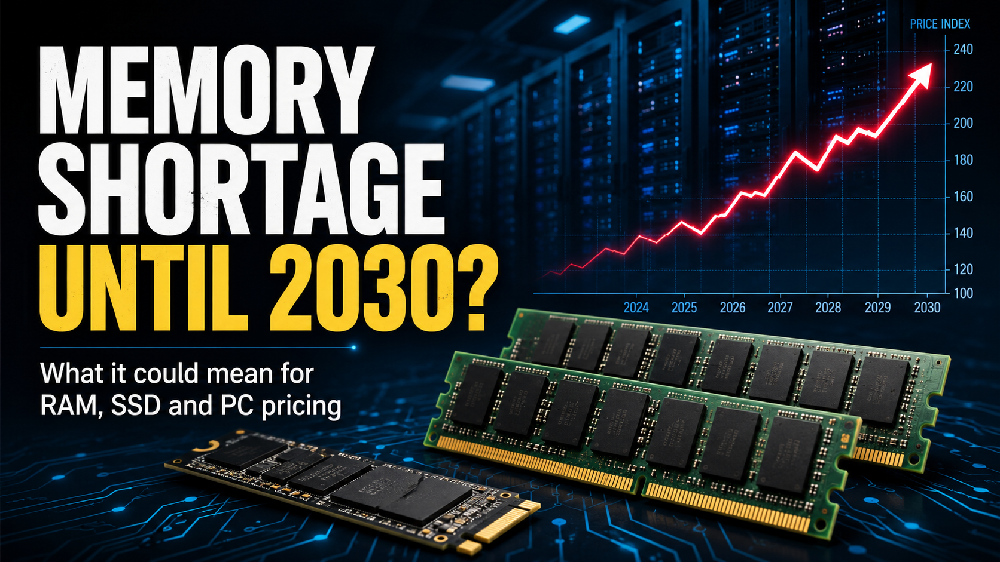
Memory Shortage Could Last Until 2030: Are Cheap RAM and SSD Prices Gone for Good?
If you have been waiting for RAM prices to return to the levels we saw a few years ago, the latest warning from one of the world's largest memory manufacturers may not be what you wanted to hear.
SK hynix believes the global memory shortage could continue through 2030.
That is a significant statement.
Memory markets have always been cyclical. Prices rise during shortages, manufacturers increase production, supply catches up and eventually prices fall again.
But the current memory cycle is increasingly looking different.
Artificial intelligence is creating enormous new demand for memory, while building enough semiconductor manufacturing capacity to satisfy that demand can take several years.
The big question for PC users, gamers and businesses is therefore:
Are affordable RAM and SSD prices eventually coming back, or are we entering a permanently more expensive era for memory?
What Did SK hynix Say?
SK hynix CEO Kwak Noh-Jung recently said the company sees continued strong memory demand with no obvious signs of a major downturn.
The company believes supply constraints could potentially remain in place through 2030.
SK hynix is one of the world's largest memory manufacturers and is particularly important in the market for HBM — High Bandwidth Memory used by modern AI accelerators.
The company is now investing billions of dollars in additional factories, packaging facilities and research centres to increase its production capacity.
It is also preparing a new facility in Indiana in the United States that is expected to begin mass production of next-generation HBM products around 2029.
Why Is Memory Demand Growing So Quickly?
The biggest reason is artificial intelligence.
AI servers require enormous quantities of memory.
This includes both specialised HBM installed alongside AI GPUs and traditional DRAM used by the servers surrounding those accelerators.
As companies including Microsoft, Google, Amazon, Meta and other cloud providers build larger AI data centres, the amount of memory required continues to increase.
The problem is that memory factories cannot simply double production overnight.
HBM Is Changing the Entire DRAM Market
HBM is one of the most important technologies behind the current memory shortage.
Instead of placing conventional memory chips next to a processor, HBM stacks multiple memory dies vertically.
This provides extremely high bandwidth and makes HBM ideal for AI accelerators.
However, HBM is considerably more complicated to manufacture than ordinary desktop DDR5 memory.
It also consumes a larger amount of manufacturing capacity.
This creates an important problem.
The more manufacturing capacity that memory manufacturers allocate to HBM, the less capacity is available for conventional DRAM.
That means the AI boom can indirectly affect the price and availability of memory used in ordinary PCs and servers.
Even NVIDIA Is Feeling the Memory Shortage
The shortage is becoming serious enough that even the world's largest AI hardware companies are reconsidering how much memory they install in future products.
Industry reports suggest NVIDIA has been evaluating different memory configurations for future Rubin Ultra AI accelerators because of concerns surrounding HBM supply.
If companies spending billions of dollars on AI infrastructure are struggling to secure enough memory, it demonstrates just how tight the supply chain has become.
Why Can't Manufacturers Just Build More Factories?
They are.
Samsung, SK hynix and Micron are all investing enormous amounts of money in additional semiconductor manufacturing capacity.
SK hynix alone recently announced approximately 54 trillion Korean won of additional investment into new manufacturing facilities in South Korea.
Micron is also building and expanding major facilities across the United States and Asia.
But semiconductor manufacturing plants are among the most complex factories in the world.
A new fab requires:
- Years of construction
- Highly specialised equipment
- Advanced cleanrooms
- Extremely complex manufacturing processes
- Long qualification periods
- Billions of euros in investment
Even after construction is completed, production cannot immediately operate at maximum capacity.
Manufacturing yields must improve gradually before a new facility becomes fully productive.
2027 Could Still Be a Difficult Year for DRAM
Current industry forecasts suggest DRAM supply will remain tight throughout 2027.
Additional factories are expected to begin increasing production, but much of the meaningful new output may not reach the market until 2028.
At the same time, AI server demand continues to grow.
This means demand could continue increasing faster than supply.
For consumers, that makes a dramatic collapse in RAM prices during 2027 increasingly difficult to expect.
Could RAM Prices Keep Increasing Until 2030?
Not necessarily.
This distinction is extremely important.
A memory shortage lasting until 2030 does not mean RAM prices must increase every month for the next four years.
Markets can still experience temporary corrections.
Consumer demand may weaken.
Manufacturers may temporarily increase supply.
Retailers and distributors may discount inventory.
Competition between memory manufacturers can also affect pricing.
Therefore, RAM prices could stabilise or even fall temporarily while the overall industry remains supply constrained.
DDR4 Could Become Even More Complicated
Older DDR4 memory presents another unusual problem.
Normally we expect older technology to become cheaper.
But major memory manufacturers are increasingly prioritising newer products.
Production capacity is moving towards:
- HBM
- DDR5
- Server DRAM
- LPDDR
- Next-generation memory technologies
This reduces production of older DDR4 products.
However, millions of computers, servers and industrial systems still require DDR4.
If supply disappears faster than demand, DDR4 prices can actually increase.
We have already seen similar situations with older memory generations in the past.
What About DDR5?
DDR5 remains the long-term mainstream standard for PCs and servers.
As production improves and manufacturers transition more factories towards newer processes, DDR5 supply should gradually increase.
However, DDR5 is competing directly with extremely profitable server and AI memory products for manufacturing capacity.
That competition could prevent consumer DDR5 prices from returning quickly to the exceptionally low levels we previously experienced.
Are SSD Prices Going to Keep Rising Too?
This is where the situation becomes slightly different.
SSDs use NAND Flash rather than DRAM.
AI data centres are also consuming enormous amounts of NAND storage, particularly through high-capacity enterprise SSDs.
That has contributed to higher SSD prices during 2026.
However, the future outlook for NAND may be less restrictive than DRAM.
New NAND production capacity and improving manufacturing efficiency could begin increasing supply during the second half of 2027.
If consumer demand remains weak at the same time, NAND supply could eventually exceed demand.
That means SSD prices could begin falling before RAM prices do.
RAM and SSD Prices May Start Moving in Different Directions
This is something consumers should watch carefully.
Historically, RAM and SSD prices often appeared to move together because both markets followed similar semiconductor cycles.
But AI is changing their supply-and-demand dynamics.
DRAM could remain structurally tight because of HBM and server demand.
NAND could potentially move towards oversupply earlier as additional production comes online.
Therefore, we could eventually see an unusual situation where SSD prices become increasingly attractive while RAM remains expensive.
Why Are Memory Manufacturers Not Expanding Faster?
There is another important reason manufacturers are being careful.
Memory companies remember what happened during previous cycles.
When manufacturers expanded production too aggressively, the market eventually became oversupplied.
RAM and NAND prices collapsed and manufacturers lost billions.
Samsung, SK hynix and Micron therefore have a strong incentive to expand production carefully rather than create another enormous oversupply situation.
In other words, manufacturers want enough production to satisfy customers while still maintaining healthy prices.
Long-Term Contracts Are Becoming More Important
Another major change in the memory market is the increasing use of long-term supply agreements.
Large cloud providers and technology companies are increasingly securing memory years in advance.
These agreements guarantee access to future production and reduce the risk that companies building billions of euros of AI infrastructure suddenly cannot obtain enough memory.
For memory manufacturers, long-term agreements also provide predictable revenue.
But there is a consequence for everyone else.
The more future production reserved by hyperscale customers, the less flexible supply becomes for smaller buyers.
Could the AI Boom Eventually Collapse?
This remains the biggest uncertainty.
Memory manufacturers are currently investing billions based on expectations that AI demand will continue growing for many years.
If that happens, the additional factories currently being built could simply be absorbed by continued AI demand.
But what happens if AI investment slows?
New factories could start producing enormous quantities of memory just as demand weakens.
That is exactly how previous memory-market crashes began.
Some analysts therefore believe that the industry could eventually move from shortage to oversupply later this decade.
If that happens, memory prices could fall significantly again.
So Will Memory Really Remain Expensive Until 2030?
Nobody can predict semiconductor prices four years into the future with certainty.
SK hynix's prediction should therefore not be interpreted as a guarantee that RAM prices will remain extremely high until 2030.
Instead, it tells us something more important:
One of the world's largest memory manufacturers does not currently expect the industry to return quickly to the oversupply conditions that previously produced extremely cheap RAM.
That changes how consumers and businesses should think about memory purchases.
Should You Wait Before Buying RAM?
If your upgrade is completely optional, waiting can still make sense.
Prices are volatile and individual products will continue going on promotion.
But if you genuinely need additional memory, waiting specifically for RAM to return to its old prices could be risky.
The market could stabilise without ever returning to previous lows.
A better strategy may be to decide how much memory you actually need and purchase when you find a good price rather than trying to predict the absolute bottom of the market.
Businesses May Need to Plan Further Ahead
The situation is even more important for businesses.
Companies planning PC refreshes, workstation deployments, servers or large memory upgrades should consider memory pricing earlier in their purchasing process.
When buying dozens of systems, even a relatively small change in RAM or SSD pricing can have a significant effect on the overall project cost.
Availability can also become a problem.
A particular memory specification that is easily available today may become difficult to source several months later.
Forward planning and early quotations may therefore become increasingly valuable.
What We Expect From 2026 to 2030
Based on today's market conditions, our current expectation would be:
2026
High prices and continued supply pressure across both DRAM and NAND.
2027
DRAM likely remains tight as AI demand continues to consume production capacity. NAND supply could begin improving later in the year.
2028
Additional semiconductor factories should start making a more meaningful contribution to global supply.
This could begin easing shortages, particularly if consumer or AI demand slows.
2029–2030
Much harder to predict.
Large amounts of new manufacturing capacity should be available by then, but AI memory requirements could also be dramatically higher.
The final outcome will depend largely on whether AI infrastructure continues expanding at today's extraordinary pace.
The Memory Market Has Fundamentally Changed
For years, consumers became accustomed to RAM and SSD prices gradually becoming cheaper.
More capacity became available every generation while prices generally fell.
AI has disrupted that trend.
Memory is no longer simply a commodity used by PCs, smartphones and servers.
It has become one of the most important strategic components of the AI industry.
That means consumers are now competing indirectly with some of the world's largest technology companies for semiconductor manufacturing capacity.
Our Take
We do not believe RAM prices will simply increase continuously until 2030.
Memory markets are too cyclical and too unpredictable for that.
Prices will fluctuate, new capacity will enter the market and there will inevitably be periods where memory becomes cheaper.
However, we also would not assume that the extremely cheap RAM prices seen during previous oversupply periods will return anytime soon.
AI demand has fundamentally changed the economics of memory production.
For consumers and businesses, the new approach may therefore be:
Don't wait indefinitely for yesterday's prices. Watch the market, buy when the price makes sense and plan important upgrades earlier.
What Do You Think?
Do you think RAM prices will eventually return to their old levels, or has AI permanently changed the memory market?
Keep following the Xpert.mt Blog for PC hardware news, buying advice and analysis of the technology industry.


