
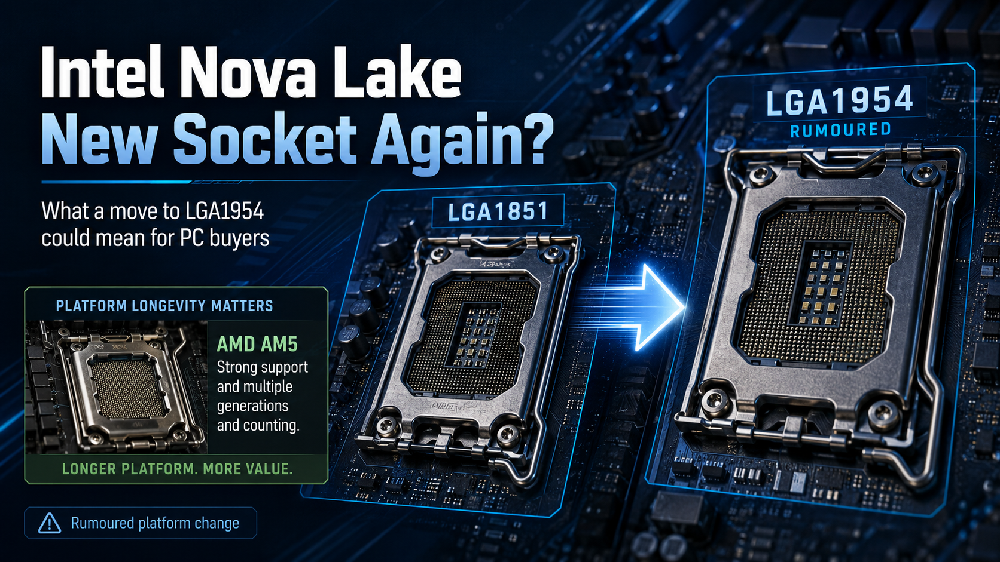
Intel's next major desktop CPU generation is getting closer, and one seemingly small detail could have a much bigger impact on PC builders than expected.
Nova Lake is expected to introduce another new Intel desktop socket: LGA1954.
That would replace the current LGA1851 platform used by Intel Core Ultra 200-series desktop processors.
For someone building a completely new PC, that may simply look like another technical specification.
But for customers who have recently invested in a high-end Intel motherboard, it can have a much bigger consequence:
A future Nova Lake CPU upgrade would likely require replacing the motherboard as well.
What Is Intel Nova Lake?
Nova Lake is the codename for Intel's upcoming Core Ultra 400-series desktop processor generation.
Current reports suggest Intel plans to begin mass production during the fourth quarter of 2026, with the first desktop processors expected to arrive in the first quarter of 2027.
The initial launch is expected to focus on a 28-core model, while higher-end configurations may arrive later.
Rumours surrounding the flagship chips are particularly ambitious, with reports suggesting configurations of up to 52 CPU cores and significantly larger cache structures.
However, many detailed specifications remain unofficial and should still be treated as rumours until Intel formally announces the complete lineup.
The Important Part: LGA1954
Today's Intel Core Ultra 200-series desktop processors use the LGA1851 socket together with Intel 800-series motherboards.
Nova Lake is expected to move to a new LGA1954 socket and a new generation of 900-series chipsets.
Reports indicate that the future lineup could include chipsets such as:
- B960
- Z970
- Z990
- Q970
- W980
That means a current LGA1851 motherboard would not simply accept a Nova Lake CPU through a BIOS update.
The electrical socket itself is different.
Why Does Intel Need Another Socket?
A new CPU socket is not introduced simply for marketing.
Modern processors continue to require more electrical connections for power delivery, memory, PCI Express lanes, communication with the chipset and other functions.
LGA1954 increases the number of contacts compared with LGA1851 and is expected to support Intel's substantially redesigned Nova Lake architecture.
Leaked platform information also points towards increased connectivity and higher-end chipset capabilities.
Some reports suggest premium Nova Lake platforms could support up to 48 PCIe lanes when CPU and chipset connectivity are combined.
Do You Need a New CPU Cooler?
Interestingly, this is one area where the transition may be easier.
Although the CPU socket is changing, LGA1954 reportedly maintains the same overall package dimensions as LGA1851 and LGA1700.
Cooler manufacturer Noctua has already confirmed that its LGA1700 and LGA1851-compatible coolers will also work with LGA1954 without additional mounting hardware.
Therefore, many existing CPU coolers may continue to be usable even though the motherboard itself will need to change.
Naturally, users will still need to ensure that the cooler can handle the thermal requirements of the specific Nova Lake processor.
Why Socket Changes Matter to PC Buyers
When choosing a motherboard, customers are not only buying the features they need today.
They are also buying into a platform.
A good motherboard can easily remain useful for five years or more.
If the socket supports several generations of processors, users may be able to perform a major CPU upgrade later without replacing the rest of the system.
If the platform ends after one main generation, that upgrade path becomes considerably more limited.
The LGA1851 Situation
Intel introduced LGA1851 for the Core Ultra 200-series desktop generation.
Intel's own compatibility documentation confirms that Core Ultra Series 2 desktop processors require LGA1851 and Intel 800-series chipsets.
Current reporting indicates that Nova Lake will instead use LGA1954.
If that happens as expected, LGA1851 will have had a relatively short lifespan compared with some previous desktop platforms.
This is particularly relevant for customers considering expensive Z890 motherboards today.
What Happens to High-End Motherboards?
Enthusiast motherboards can represent a significant part of a PC's total cost.
Premium boards often provide:
- High-end power delivery
- Multiple PCIe 5.0 slots
- Advanced networking
- More NVMe storage
- USB4 connectivity
- Better audio
- Overclocking features
Customers purchasing these products often expect to keep them for several years.
A socket change does not make the motherboard obsolete — the system will continue working exactly as before.
But it does remove one important option:
Upgrading to the next major CPU generation without replacing the board.
There Is Also a Warranty Problem
Socket transitions create another issue that PC buyers may rarely think about: warranty replacement stock.
Imagine purchasing a premium motherboard today with a two or three-year warranty.
Two years later, that platform may no longer be actively manufactured.
If the motherboard fails under warranty, an identical replacement may no longer be available from local stock.
In that situation, the board may need to be sent through the manufacturer's RMA process rather than being replaced immediately.
That can leave the customer without their main PC while the warranty claim is processed.
This is one reason platform longevity matters beyond simple CPU compatibility.
Socket Changes Also Affect Retailers and Distributors
A new CPU generation creates a difficult balancing act for retailers and distributors.
As the next platform gets closer, enthusiasts often begin delaying purchases.
Someone considering a €300 or €400 motherboard may decide to wait a few months for the next generation instead.
Demand for existing premium models can therefore slow before the new hardware actually launches.
Retailers must reduce inventory early enough to avoid being left with large quantities of expensive older-generation stock.
But reducing stock too early creates another problem.
Existing customers still need replacement motherboards for repairs, warranty claims and upgrades.
Managing that transition is considerably easier when a socket remains active across several CPU generations.
This Is Where AMD Currently Has an Advantage
AMD has taken a noticeably different approach with its desktop platforms.
Socket AM4 originally launched in 2016 and remained relevant across several Ryzen generations.
AMD has continued releasing processors for AM4 many years after its introduction.
Its successor, Socket AM5, launched alongside Ryzen 7000 and currently supports Ryzen 7000, Ryzen 8000 and Ryzen 9000 processors.
AMD has now officially extended its AM5 platform commitment through 2029.
That gives customers buying an AM5 motherboard today considerably more confidence that future processor upgrades may remain available on the same platform.
A BIOS update may still be required depending on the motherboard and processor generation.
Longer Socket Support Does Not Automatically Make AMD Better
Platform longevity is only one factor when choosing a processor.
Performance, price, power consumption, motherboard features, availability and the workload itself remain extremely important.
Intel may offer the better CPU for a particular application or budget.
AMD may offer the better choice in another.
But for customers who regularly upgrade their processors, socket longevity deserves to be part of the purchasing decision.
Intel May Be Changing Its Approach with LGA1954
There is an interesting twist to this story.
Although LGA1954 represents another platform change, reports suggest Intel may intend to keep this socket for considerably longer.
According to current leaks, LGA1954 could support Nova Lake, a future generation referred to as Razor Lake, and potentially processors beyond that.
If those reports prove accurate, Intel could be moving towards a longer-lived desktop platform strategy similar to what enthusiasts have been asking for.
That would make LGA1954 considerably more attractive as a starting point for a new high-end system.
However, until Intel officially confirms the complete socket roadmap, customers should treat long-term compatibility claims as unconfirmed.
Should You Avoid Buying Intel LGA1851 Today?
Not necessarily.
Technology purchasing should always be based on what you actually need.
If you need a new PC today and a Core Ultra 200-series processor provides the performance, features and price you want, the system will not suddenly become slower because Nova Lake launches.
A good PC purchased today can still provide many years of excellent performance.
However, customers planning frequent CPU upgrades should understand that current information points towards Nova Lake requiring a new motherboard.
When Does Waiting Make Sense?
Waiting may make more sense for enthusiasts who:
- Already own a capable PC
- Plan to purchase a very expensive motherboard
- Want the longest possible upgrade path
- Regularly replace their CPU while keeping the same platform
- Are specifically interested in Nova Lake performance
For someone whose existing computer is no longer meeting their needs, waiting indefinitely for the next generation often provides little benefit.
There will always be another CPU generation on the horizon.
What We Know About Nova Lake So Far
Based on currently available reports, Nova Lake is shaping up to be one of Intel's most ambitious desktop launches in recent years.
Rumoured features include:
- Up to 52 CPU cores on flagship models
- Large additional cache configurations on gaming-focused processors
- New LGA1954 socket
- New Intel 900-series chipsets
- PCIe 5.0 connectivity
- Continued DDR5 memory support
- Potentially substantially improved gaming performance
The first Nova Lake desktop processors are currently expected around early 2027, although launch schedules can always change before official release.
Our Take
Socket changes rarely receive the same attention as core counts, clock speeds or gaming benchmarks.
But for someone buying a complete PC, the socket can have a bigger long-term impact than many headline specifications.
A longer-lived platform gives customers more upgrade flexibility, helps maintain motherboard availability and can make warranty replacement planning easier.
AMD currently has a clear advantage in this area because AM5 is officially supported through 2029.
Intel's move from LGA1851 to LGA1954 may therefore frustrate some users who recently invested in a premium Intel motherboard.
However, there is also reason for optimism.
If reports that LGA1954 will support several future Intel CPU generations prove accurate, Nova Lake could mark the beginning of a much longer-lived Intel platform.
That would be good news for gamers, PC builders, retailers and everyone managing systems over several years.
Which Do You Prefer?
Would you rather move to the latest platform more frequently to access new technology, or keep the same motherboard for several CPU generations?
Keep following the Xpert.mt Blog for PC hardware news, buying advice and analysis of the latest technology developments.


